
The information presented in this article is for educational and research purposes only, intended for laboratory professionals, researchers and collaborators. This content does not constitute medical or clinical advice.
Table of Contents
Selecting the right solvent for peptide reconstitution affects stability, contamination risk, and experimental consistency in laboratory research. The two primary options—bacteriostatic water and sterile water—serve different research needs based on usage timeline and application requirements.
Understanding the differences between these reconstitution solutions helps laboratories make informed choices that support reliable in vitro protocols.
Takeaways
- Bacteriostatic water contains 0.9% benzyl alcohol preservative enabling multi-dose use for up to 28 days
- Sterile water provides maximum purity but requires single-use within 24-48 hours after opening
- Cell culture applications typically require sterile water due to benzyl alcohol cytotoxicity concerns
- Choice depends on experimental timeline, peptide sensitivity, and whether preservatives interfere with assays
What is Bacteriostatic Water for Peptides?
Bacteriostatic water is sterile water containing 0.9% benzyl alcohol as a preservative. The benzyl alcohol inhibits bacterial growth and reproduction without actively killing bacteria.
This preservative property gives bacteriostatic water its key advantage: multi-dose capability. Once opened, a vial remains sterile for up to 28 days when proper aseptic technique is maintained.
The solution maintains a pH range between 4.5 and 7.0, typically around 5.7. Benzyl alcohol is naturally derived from plants and found in fruits and tea leaves, offering low toxicity at the 0.9% concentration used.
Research indicates that peptides reconstituted with bacteriostatic water can remain stable for several weeks when stored at 2-8°C. This extended shelf life reduces waste and maintains consistency across multi-day protocols.
The preservative protection makes bacteriostatic water particularly valuable for:
- Research protocols requiring repeated peptide access over days or weeks
- Multi-dose vials where contamination risk must be minimized
- Extended experimental timelines with consistent peptide concentration needs
- Laboratory workflows where reconstituting fresh solution daily isn’t practical
What is Sterile Water?
Sterile water is the purest reconstitution option. Simply water that has been sterilized with no additives or preservatives. This purity makes it ideal for applications where any additional chemicals could interfere with experimental results.
The absence of preservatives means sterile water lacks antimicrobial protection once the vial is opened. It’s designed strictly for single-use scenarios.
Peptides reconstituted with sterile water typically have a shelf life of only 24-48 hours, even when refrigerated. The lack of preservatives allows bacterial contamination and degradation to occur more rapidly.
For experiments requiring immediate use of the entire reconstituted solution, sterile water provides an excellent option. It eliminates exposure to preservatives while offering cost savings for high-volume single-use applications.
Sterile water works best when:
- The entire reconstituted peptide will be used in a single session
- Maximum purity without any additives is required for the protocol
- Cell culture experiments demand preservative-free conditions
- Budget constraints favor the more economical single-use option
- Sensitive assays might show interference from benzyl alcohol
Research Application Considerations
Cell culture applications present unique constraints on reconstitution solution selection. Benzyl alcohol exhibits cytotoxicity toward certain cell types at concentrations used in bacteriostatic water.
For cell-based assays, sterile water is typically the preferred choice. If using bacteriostatic water is required, researchers must ensure the peptide solution is diluted significantly in culture medium to reduce benzyl alcohol below cytotoxic thresholds.
Multi-day experimental protocols benefit from bacteriostatic water’s contamination protection. The preservative acts as a guardian against microbial growth, allowing consistent peptide access throughout extended studies.
Analytical work may require sterile water when preservatives could interfere with sensitive detection methods. Mass spectrometry, HPLC analysis, and certain enzyme assays can show unexpected peaks or signal interference from benzyl alcohol.
Other Peptide Reconstitution Options
Some research applications benefit from alternative solvents beyond basic water:
- Normal Saline (0.9% NaCl): Provides an isotonic solution that mimics physiological conditions. Available in both sterile and bacteriostatic formulations.
- Important limitation: Saline is not recommended for peptides in acetate salt form, as sodium chloride can react with acetate groups causing precipitation.
- Phosphate-Buffered Saline (PBS): Maintains stable physiological pH (approximately 7.4) with appropriate ionic strength. Excellent for pH-sensitive peptides that may degrade under varying conditions.
- Specialized Solvents: Dilute acetic acid or DMSO may be required for highly hydrophobic peptides or sequences with poor aqueous solubility.
Making the Right Choice for Your Laboratory
The decision between bacteriostatic water and sterile water depends on your specific research requirements and experimental design.
Laboratories may choose bacteriostatic water when:
- Working with multi-dose peptide vials requiring repeated access over days or weeks
- Conducting extended research protocols where peptides must remain stable in solution
- Minimizing contamination risk is a priority for experimental validity
- The peptide application tolerates benzyl alcohol (not for highly sensitive cell culture)
- Cost-effectiveness through reduced waste is important
Laboratories may choose sterile water when:
- The entire reconstituted peptide solution will be used immediately in a single session
- Performing cell culture experiments where benzyl alcohol cytotoxicity is a concern
- Working with sensitive assays where preservatives could interfere with results
- Maximum purity without any additives is required for the protocol
- Fresh daily reconstitution aligns with existing laboratory workflows
Quality Control Considerations
Researchers should source reconstitution solutions exclusively from reputable suppliers with established quality control procedures. Sterility verification and endotoxin-free certification are required for reliable laboratory work.
Look for suppliers providing:
- Certificate of Analysis (CoA) documenting pH, preservative concentration, and purity
- USP (United States Pharmacopeia) compliance for pharmaceutical-grade applications
- Endotoxin testing results (particularly for cell culture work)
- Proper storage and handling documentation
Third-Party Tested, USA-Made, 99% Purity
Order 100% USA-Made peptides for your laboratory applications.
Reconstitution Best Practices
Peptide reconstitution protocols are as important as solvent selection for maintaining peptide integrity in laboratory protocols.
Aseptic Technique Requirements
All reconstitution procedures must employ strict aseptic technique to prevent microbial contamination:
- Work in a clean environment, preferably within a laminar flow hood when available
- Clean rubber stoppers with 70% alcohol swabs before needle insertion
- Use sterile syringes and needles for all transfers
- Never touch needle tips or allow contact with non-sterile surfaces
Proper Addition Method
The physical method of adding solvent significantly impacts reconstitution success. Never aim the solvent stream directly at the peptide powder, as this causes foaming and potential denaturation.
The correct technique:
- Draw the calculated volume of sterile solvent into a syringe
- Insert the needle through the rubber stopper at an angle
- Direct the solvent stream against the inner vial wall, allowing it to run down slowly
- Remove the needle once all solvent is added
- Allow the vial to sit undisturbed for several minutes for passive dissolution
Gentle Mixing Protocol
After solvent addition, gentle swirling promotes complete dissolution without damaging peptide structure. Vigorous shaking should be strictly avoided, as mechanical stress can disrupt peptide bonds and compromise integrity.
If the peptide does not dissolve readily with gentle swirling, brief sonication may be employed cautiously. Note that sonication can cause solution warming and potential degradation.
Storage and Labeling
Reconstituted peptides should be stored at 2-8°C in standard refrigeration. Never store at room temperature for extended periods.
Acceptable storage duration depends on the solvent:
- Bacteriostatic water reconstitutions: Up to 28 days under proper conditions
- Sterile water reconstitutions: 24-48 hours maximum
Label all reconstituted peptide vials clearly with:
- Peptide name and lot number
- Reconstitution date
- Solvent type (determines stability timeline)
- Final concentration with units
- Expiration date based on solvent used
Monitor solutions visually for any signs of contamination, precipitation, or discoloration throughout the storage period.
Research-Grade Reconstitution Solutions from BioLongevity Labs
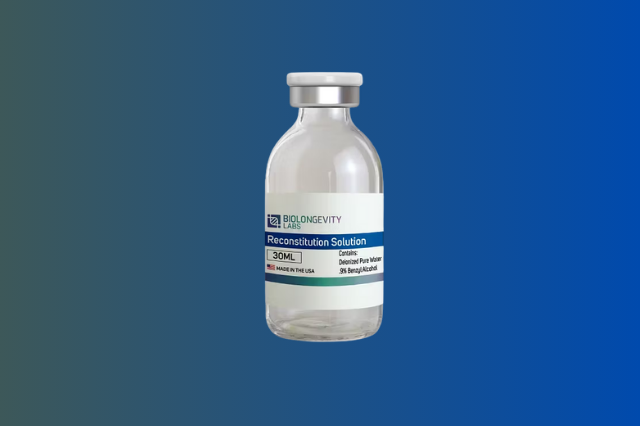
BioLongevity Labs provides lab-grade bacteriostatic water for laboratory peptide research. All products are manufactured in USA GMP facilities with complete documentation.
Our reconstitution solutions are strictly for research use only and intended for in vitro laboratory applications. They support reliable peptide reconstitution protocols with the quality documentation research professionals require.